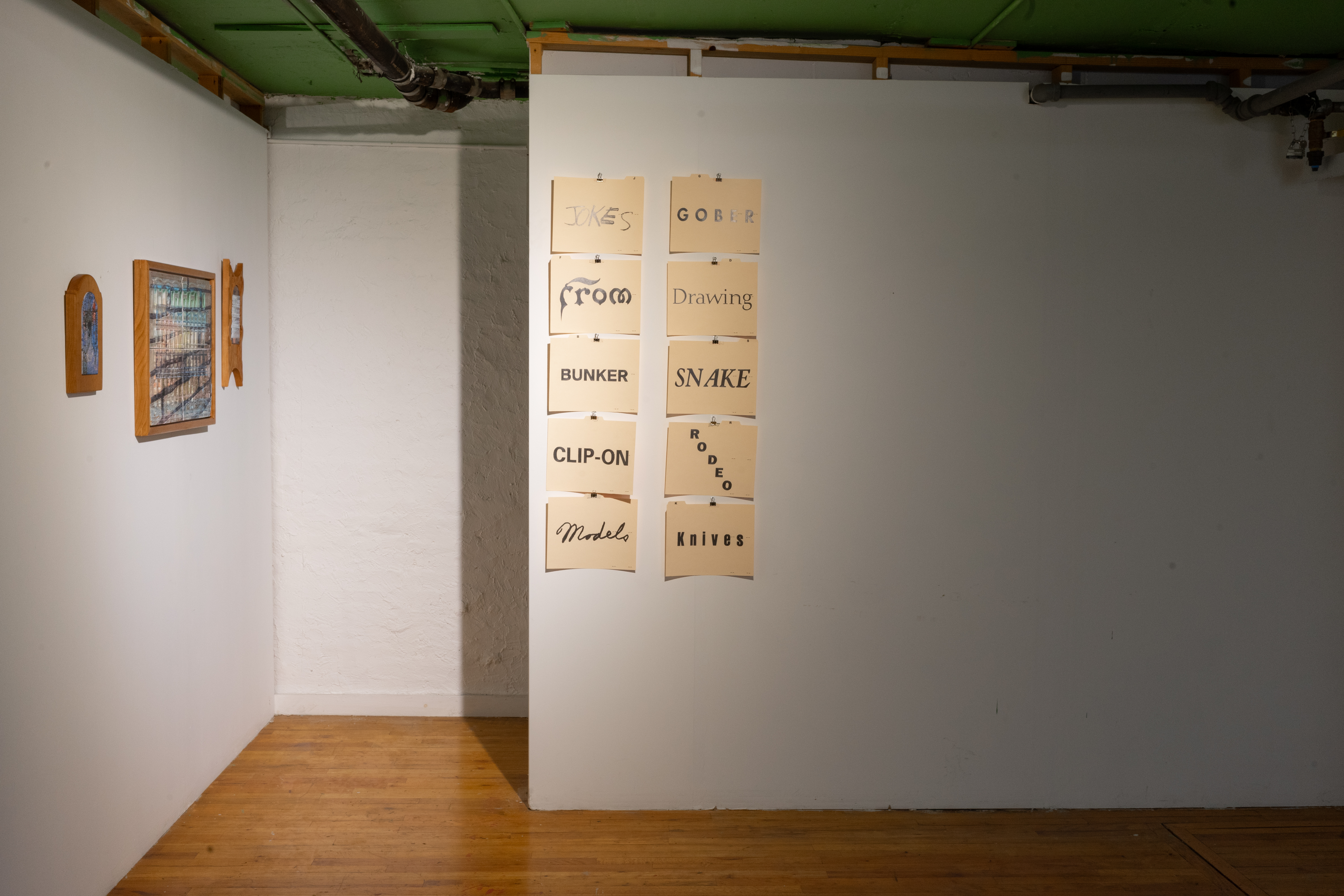
AGGLOMERATE
Peter Brock
Neal Cashman
Harry Gould Harvey IV
Brittni Ann Harvey
Clare Koury
Bryce Kroll
Simon Petepiece
Hanna Umin
Charlotte Zinsser
Organized by Zero Point and New Uncanny
May 23 - June 15, 2025
41 Bleecker Street, New York
Here saw I people, more than elsewhere… They clashed together, and then at that point, Each one turned backward, rolling retrograde, Crying, “Why hoard?” and “Why squander?
Dante, Inferno, 7.30
In medical discourse, hoarding is imagined as a negative impulse. It is a refusal to let go, and embrace the ephemerality of one’s possessions, lest they be useful later on. The practice is stigmatized on these terms. Hoarding is classified as a disorder once the space and circumstances of the subject’s life are subordinated to the act of accumulation. The aKirmative reasons for hoarding are dismissed as irrational, or derided as contradictory to healthy participation in social life. How can one best protect against the entropy which governs our everyday lives? How does one meet our crisis of precarity without armor, either psychic or physical? To hoard is to prepare, to buttress, to remember, and to soothe. Hoarding is a response to and negation of consumption. It is a refusal to purchase without reason or squander what one already has. Unlike “prepping,” stockpiling, or collecting, hoarding comes from instability. Deprived of the resources to plan eKectively for a diKicult future, the hoarder grabs what they can. The hoarder knows all this implicitly, and works from subconscious drives. Each object fulfills an infinite number of purposes in an infinite number of potential futures, all specific predictions which correlate to the subject’s doubts and shortcomings. Hoarding is not just clutter; it is not just pollution. It is a system, a means with which one insulates themselves from the world outside and the world ahead. What is an appropriate material culture for such bleak prospects? Our classical equivocation of hoarding and squandering is misaligned. We are all hoarders, especially those of us who waste the most. The ephemera of our lives never goes away—it is cleared from the shelves of our homes into landfill islands and atmospheric pollution, permanently haunting our world. By electing to hoard, we keep our agency and disobey the doctrines of planned obsolescence and consumer utility. New uses for these items can always be invented, and new value can always be conferred. By keeping our possessions, we reserve the right to look at them again, deciding how and when they will take on their new lives.
-Theo Belci